
What if grief isn’t just something we feel—but something our bodies carry? And how can somatic funerals help us move forward with grief?
Since living with Long Covid (by the time of writing 2,5 years and counting), I have learned to understand my condition not only as a physical challenge, but also as a somatic one: a deeply embodied experience of disruption and grief. In the absence of a medical cure, I tried a range of therapies. Most fell short, but one approach shifted something fundamental: somatic practices.
These gentle, body-based techniques such as breath work, mindful movement and nervous system regulation haven’t ‘fixed’ my condition. Instead, they have helped me be present with it and navigate it with more compassion. They have made me more aware or the connections between body, mind and spirit, and given me a language for safety and resilience.
This raised the question: if somatic practices can help with chronic illness, what might they offer to people moving through grief?
That’s how I discovered somatic funerals: a powerful and compassionate way of honouring loss not just with words, but with the body itself.
What are somatic funerals?
As a celebrant, I often witness a quiet transformation in people’s bodies during a funeral. At the start of the service, people often arrive tense and withdrawn. But by the end, something softens. It is as if a weight has been lifted. People stand a little taller, their breathing deepens, their voices steady, and they’re more open to connecting with those around them.
This shift speaks to something profound: grief is not just emotional or spiritual, it’s also physical.
A somatic approach to funerals recognises that grief is a multifaceted experience: one that encompasses every part of who we are. It acknowledges that funerals are not solely emotional, mental, or spiritual rites, but also deeply physical ones.
When grieving, it is natural to feel ‘disembodied’: this is the nervous system’s survival response. It tries to protect you. The nervous system perceives grief as a threat: we move from a place of safety to a place of fear.
How somatic funerals help us come home to our body
Our body ‘carries’ the weight of grief. Grief lives in the body, and somatic funerals respond to this by incorporating movement, breath work, touch, body-centred rituals, and safe, attuned connection with others. They incorporate rituals that involve our bodies and senses as a physical anchor for the various aspects of grief.
Somatic funerals invite us to craft ceremonies that go beyond words: rituals that meet the nervous system with care, and help the body begin to release, soften, and find a sense of safety in the midst of loss.
Somatic funerals offer a way to move with grief, not just talk about it. They are an invitation to create ceremonies that go beyond language: funerals that meet the body where it is, and help it begin to be present with grief in a mindful and compassionate way.
Somatic rituals as physical anchors for grief
Examples of somatic rituals are:
- Lighting a candle
- Engaging in mindful movement or dance
- Touch
- Listening to calming music
- Singing
- Message writing
- Placing a hand on your heart
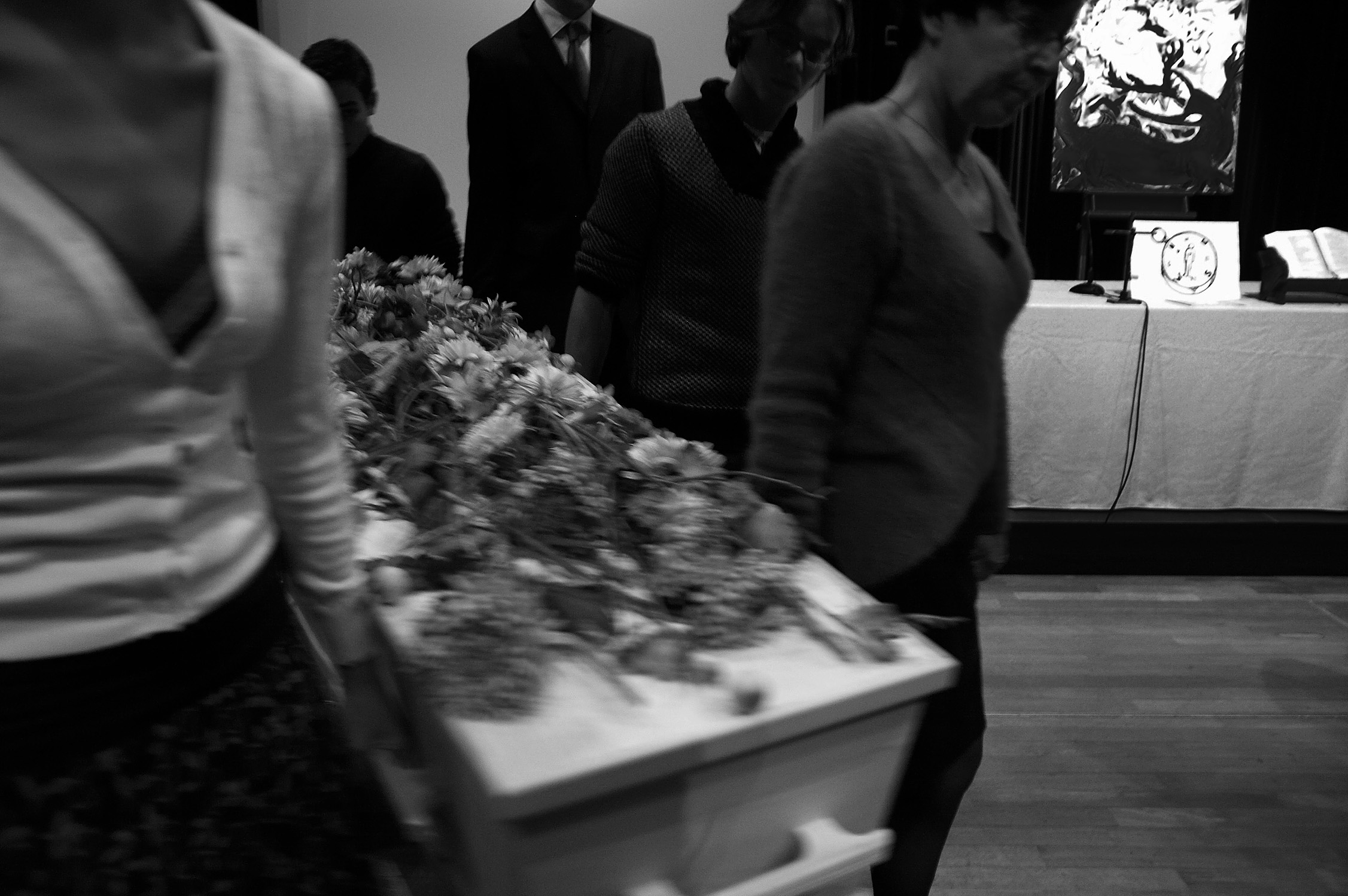
- Carrying a coffin
- Backfilling a grave
- Mindfully placing a flower with the coffin

Many of these elements are already present in funeral services, but I believe that there is an opportunity to become more mindful of the impact of somatic rituals and design funerals around these rituals.
A somatic approach to funerals is an invitation to craft funerals ‘ beyond the words’ and design the ceremony from a holistic, embodied perspective.
Anoushka’s funeral: how movement helped transform body, mind and spirit
Here is an example of a funeral that was designed around somatic practices. The funeral was for Anoushka, a renowned Pilates teacher and I am very grateful to her family who allow me to share this story.
Anoushka’s funeral was a deeply personal, spiritually inspired ceremony that honoured her love for movement and her belief in an eternal soul. Her husband Mike wanted to incorporate motion and symbolic elements into the ritual. He found inspiration from a scene in the movie Avatar where the Na’vi dance around the Tree of Souls.
The ceremony unfolded in two parts. The first honoured Anoushka’s life through spoken tributes, music, and the symbolic act of family members carrying her coffin. As Mike would reflect afterwards, the weight served as a tangible expression of their grief.
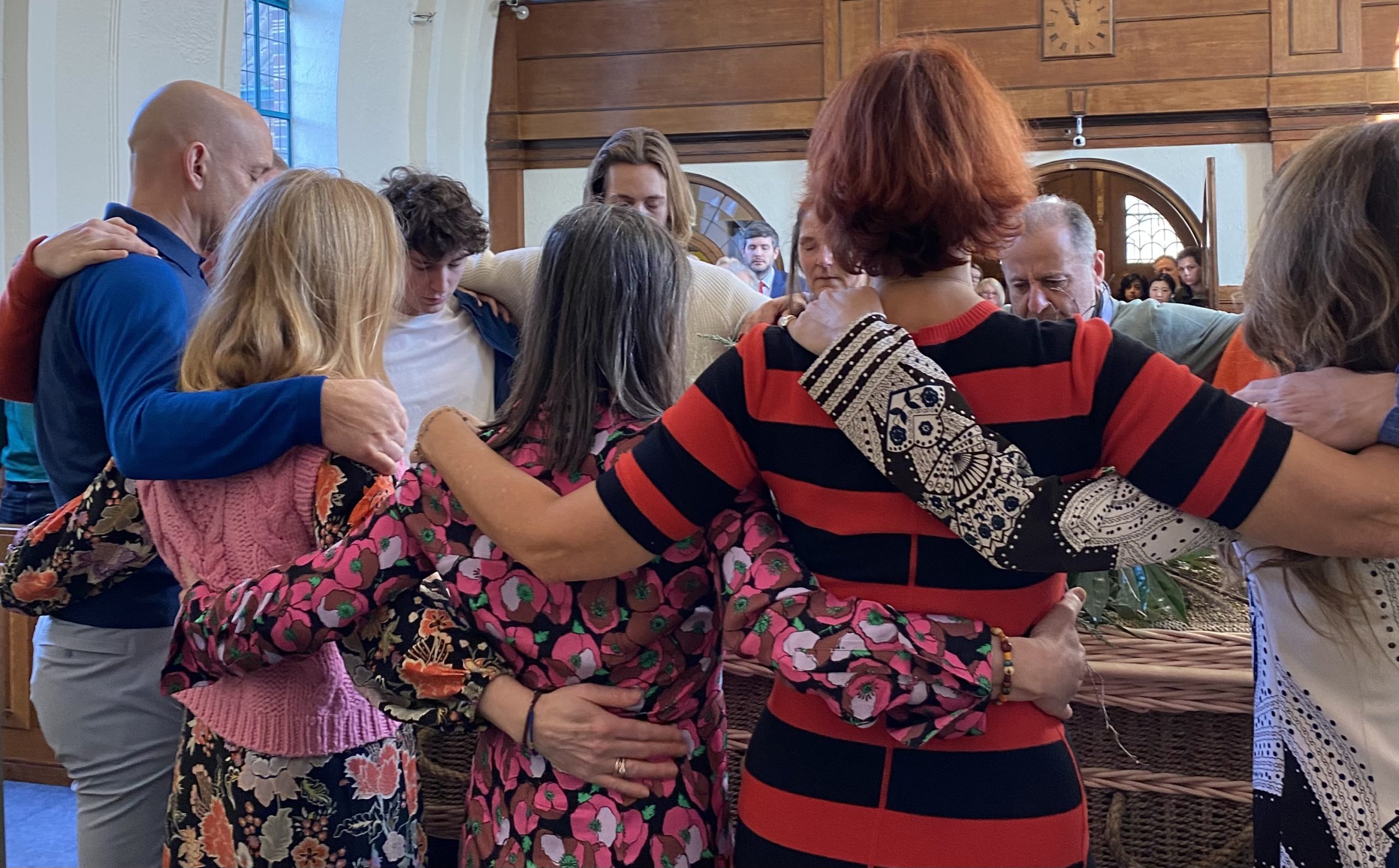
The second part invited movement and quiet connections through mind, body and spirit. Anoushka’s sister, yoga teacher and former choreographer, led a guided meditation during which a select group of family and friends came forward to form a circle of dancers around Anoushka’s coffin. Everyone else could hold each other – touch shoulders or upper backs, hold hands, or hug each other, whatever felt comfortable to each individual.
The dancers slowly moved their bodies in their circular embrace while all others created a vortex of energy towards Anoushka’s coffin – their gift to her as they accompanied her soul onto its next journey. Colourful ribbons were dropped from the balcony, symbolising a rainbow bridge between heaven and earth.
The ceremony concluded with an upbeat Prince song, inviting attendees to re-enter life through dance.
Embodied choices throughout the funeral encouraged participation, connection, and healing. Anoushka’s husband shared how the ritual’s beauty transformed his emotional and physical state.
Anoushka’s body remained central throughout: a continuing embodiment of her identity and presence, which made the experience feel communal, transformative, and therapeutic.
How to craft somatic funerals: challenges
When I tell people about Anoushka’s funeral and other somatic funerals, people respond with enthusiasm. Many people assume that a funeral service has to follow a particular structure in which spoken word, prayers (or poetry in non-religious services), and hymns (or music) form the key elements. This applies to people who are organising a funeral for their person, but also to funeral directors and celebrants.
Celebrants are trained with a focus on writing and delivering a good eulogy and finding suitable poetry to express a sentiment or capture someone’s interest.
Another reason why funerals are often structured in a similar way is because of the design and layout of most crematorium chapels, and the rigid timeslots. Both are not aimed at spontaneous movement or rituals that don’t work on a timer.
As a result, a funeral service often takes the form of an officiant leading the service from a lectern whilst the mourners sit in the pews, waiting for guidance and instructions.
Every funeral can be somatic if we think and act ‘beyond the words’
However, somatic funerals don’t have to be elaborate events. Every funeral can incorporate embodied elements. Some thoughts:
- Space and time limitations don’t have to be an excuse to NOT to include dance in funeral services. Anoushka’s funeral took place in a conventional crematorium. We designed the dance and meditation with what was possible in the space. What we did do though, was book a triple slot to make sure we would not feel rushed and had time to set up. A funeral like this requires excellent team work between the family, officiant, funeral director and crematorium staff.
- Including embodied practice in ritual does not have to be a big event. It can be done by small gestures or movements, Such as inviting people to place a hand on their heart during farewell words, inviting them to smell the flower or sprig of rosemary before mindfully placing it with the coffin, holding hands to express support and shared love, or including a meditation instead of a spoken prayer.
Somatic funerals require that officiants, funeral directors and crematorium staff understand the importance of embodied rituals. Celebrants in particular need to have the knowledge and skills to design and facilitate these rituals in funeral ceremonies, as well as creating a safe and inclusive space where people feel allowed, free and comfortable to take part, or opt out, if they prefer. Space and time can contribute to this – so when a crematorium chapel is not the right place from a ritual perspective, an alternative venue could be considered.
Curious to learn more about somatic funerals? Get in touch!
I am here to help! If you are organising a funeral and are curious how to include somatic practices, get in touch via rosalie@ritualstoday.co.uk. And if you are a celebrant who would like to learn more about somatic funerals, get in touch for one or more mentoring sessions.